
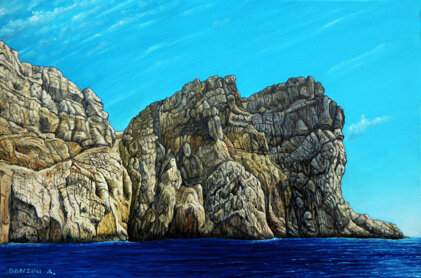
Deep blue (Sardinia)
oil on canvas 40 x 60
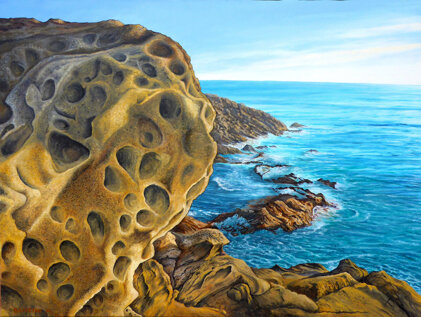
Oppression and freedom
oil on canvas cm 60 x 80
Livornese perspectives
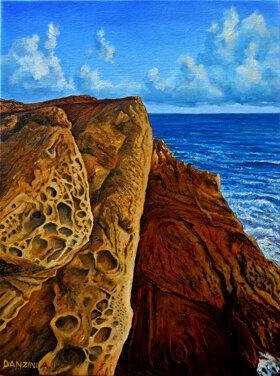
Along the cliff
oil on canvas 60 x 40 cm
oil on canvas 40 x 30 cm
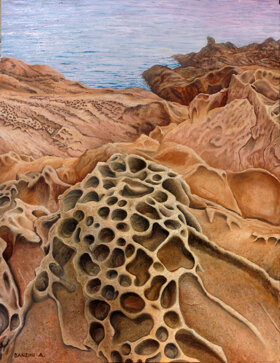
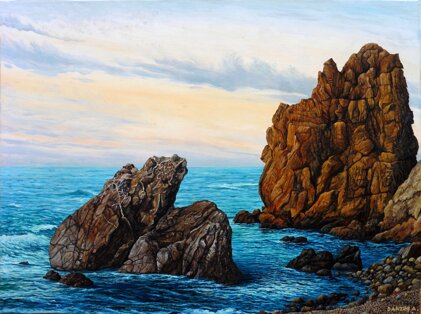
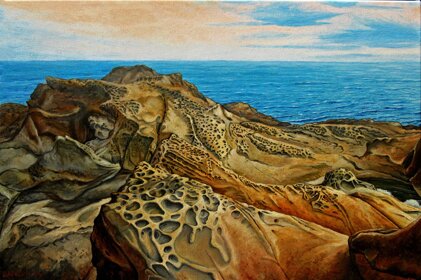
Witnesses of time
oil on canvas cm 60 x 80
The great embroidery
oil on canvas cm 80 x 60
About his Art
The Critique
Alessandro Danzini, born in Pisa in 1974, has always lived in Livorno.
Starting from the important tradition that characterizes the Tuscan school, he has arrived at a painting in which the analysis of detail, the care for particulars, the carefully studied construction, and the precision of the stroke, distance themselves from any legacy of the Macchiaioli flavor.
The images depicting the Tuscan coast, landscapes, views, seascapes, are rendered with pronounced realism, yet far from a faithful and cold representation of objective reality.
These are unprecedented perspectives, which have nothing of the postcard landscape, but instead offer more intimate interpretations. The flavor of the sea, the vibrant light, the intense blues stimulate our emotions. But the focus is on the rock. In the foreground, at an angle that distorts the proportions, we see it harsh, tormented, lacerated, battered by the force of salt, wind, and sea. A dialogue between the impetuous motion of erosive agents and the powerless immobility of the rock, between destructive action and the genesis of great beauty. The play of light in the wounds of the rocks, the admirable architectures, the spectacular color variations of the concretions, are a hymn to the shaping force of nature, generator of extraordinary wonders. At the same time, a reminder of the transience of ephemeral earthly life, of the precariousness and frailty of all things.
Maria Teresa Majoli
His Biography
Alessandro Danzini was born in Pisa in 1974.
However, he spends his entire life in nearby Livorno, a city he deeply loves.
And which gives him a lot in return: not by chance, the Livorno coastline, its jagged shores, and its picturesque views represent some of the main and happiest sources of inspiration for the artist.
The call of art is, as with every respectable painter or sculptor, a natural factor that is born and develops right from the start: already at a young age, Danzini feels within himself the almost visceral need to draw and use colors, showing uncommon abilities. As well as a particular attention to "landscape" painting, a genre that remains dear to him for much of his artistic journey.
It is precisely to these youthful years that we owe his studies on the great Impressionist masters, the most celebrated Macchiaioli, and also some important contemporaries: remarkable works executed in pencil and chalk, considered by the artist himself mainly as a search for a technique he wants to perfect more and more.
These studies lead him to consider other aspects of the landscape genre: perspective construction, theories of optics, the study of architecture; while he discovers and appreciates technical drawing, as a tool that offers him solid foundations on which to build his views.
From these considerations comes the choice to devote himself to these subjects by attending the Technical Institute for Surveyors "B. Buontalenti" in Livorno, a high school with an excellent reputation.
For a period, he is also led astray by some of the teachings he learned, thanks to the excellent results he achieves in technical and design drawing, dedicating much of his time to developing a solid graphic technique and a targeted analysis of the history of architecture.
These notions will definitively shape his educational path, both in choosing the University of Pisa as his reference center, and in his degree, discussing an intuitive thesis in Urban History (“The urban development of the eastern area of Livorno at the beginning of the 20th century”).
During his university studies, now certain of the teachings he received, Danzini finally returns to true painting, renewed in intent and technique: it is precisely the tempera on paper works from this period that inaugurate his new artistic season, works that the artist himself defines as "still unripe" but which already show the objectives of the years to come.
As a long-standing painter, he adopts – and this is a courageous choice and a harbinger of further refinements – oil color as a fundamental means of pictorial translation: this choice, if from a purely visual point of view, allows the artist to make his views more fluid, it also forces him to pay almost obsessive attention to the creative process; and consequently to an ever-increasing technical awareness that does not allow for distractions – although he accepts reconsiderations.
In the choice of his views, in the analysis of landscapes and vistas, the lessons of his beloved Impressionist masters, those of the Macchiaioli, and plein air painting in general return once again, this time approached with a fidelity to reality that he has learned from his contemporary studies on seventeenth-century painters. Teachings that lead him to develop his own personal figurative language that finds expression in a renewed, almost lenticular landscape painting, making him one of the most accredited and appreciated representatives among professionals.