
FRANCESCA GUETTA - Italy
contacts: info@francescaguetta.com Website http://www.francescaguetta.com
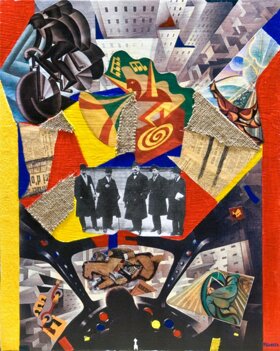
Tribute to Futurism 3
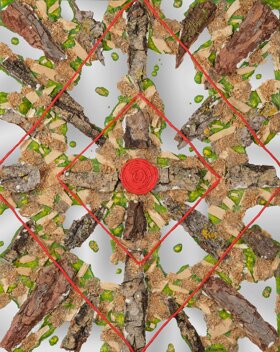
The Harnessed Nature XXII
mixed media on canvas board - 50 x 40 cm - 2009
polymaterial, aluminum and acrylic on canvas - 50 x 40 cm - 2020
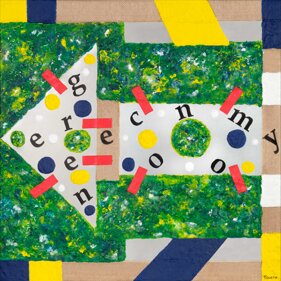
Towards the future
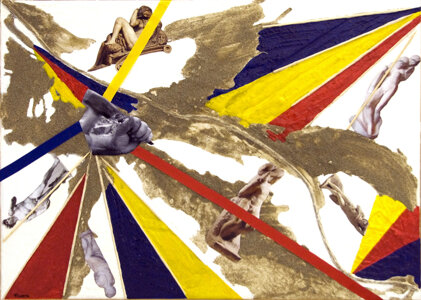
Tribute to Michelangelo III
polymaterial, aluminum and acrylic on canvas - 50 x 50 cm - 2023
mixed media on canvas - 50 x 70 cm - 2011
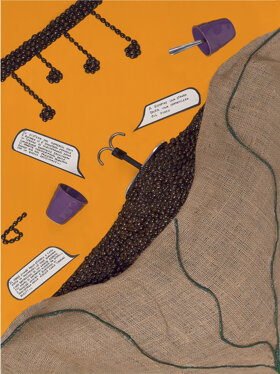
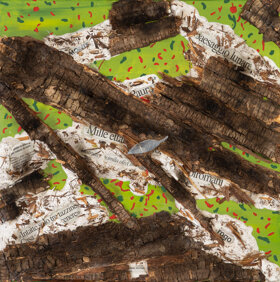
All up in smoke
Coffee notes
polymaterial and acrylic on canvas cm 40 x 40 2018
polymaterial on canvas cardboard mounted on board cm 70 x 50 2015
About her Art
Florentine artist since 2010, she has been a regular presence at group events. In this regard, her works have been presented in institutional venues, museums, and prestigious galleries in Florence, Brussels, Rome, Monte Carlo, Palermo, Genoa, Taranto, Milan, Amsterdam, Berlin, Paris, Vienna, Miami, Naples, London, Stockholm, Portofino (Ge), Madrid, etc. Among her most recent solo exhibitions are: “A grain, a scent for the world…Waiting for the Expo”, Florence, Agronomic Institute for Overseas – Italian Ministry of Foreign Affairs and International Cooperation, Florence, 2015; “Fragments of stories and colors”, Monumental Complex Guglielmo II, Monreale (Pa), 2018; “Dialogues in the making”, Simultanea Spazi d’Arte, Florence, 2018; “Between Surrealism and Abstractionism – Three parallel paths” Society of Fine Arts, Artists’ Circle, Dante’s House, Florence, 2019; “Nature harnessed”, White Cube Gallery, Veroli (Fr), 2022; “A cluster of intriguing stylistic features”, La Bomboniera dell’Arte Gallery, Rome, 2022. Other prestigious participations include her presence at all editions of the Triennial Exhibition of Visual Arts in Rome, from 2011 up to the synopsis of one of her works in the Grenada National Pavilion at the 59th Venice Biennale. Her works have been published in more than one hundred catalogues produced for the exhibitions in which she has participated. One of her works is on permanent display at the Tax Office of Sesto Fiorentino (FI). One of her works is included in the permanent collection of contemporary art at the "Giuseppe Sciortino" Museum in Monreale (PA). She is included in the prints and drawings collection of the Vittorio Sgarbi collection. Her works are on permanent display at Cast – Edil Srl in Florence. Her name appears in the Contemporary Art Yearbook edited by Vittorio Sgarbi (EA Editore, 2014), in CAM 50 and 55 (Giorgio Mondadori Editore), in Art in America – Museums, Galleries, Artists 2018 Guide, in Art in America – The Guide: Museums, Galleries, Artists 2019, in Art in America – Art in America Guide: Museums + Galleries + Artists 2020 – 2021 and since 2019 in the De Agostini Contemporary Art Atlas edited by Daniele Radini Tedeschi and Stefania Pieralice. Those who have written and/or spoken about her work include: Giovanna Laura Adreani, Nella Guelfi, Barbara Angiolini, Faustina Tori, Paolo Levi, Roberto Lasciarrea, Alfonso Confalone, Carmelina Rotundo, Sossio Settembre, Manrico Testi, Salvatore Russo, Daniele Radini Tedeschi, Dino Marasà, Fabio Bianchi, Mariarosaria Belgiovine, Daniela Pronestì, Pompea Vergaro, Lidia Silanos, Roberta Filippi, Letizia Lanzarotti, Lucia Benvenuti, Elisa Siliatici, Francesco Chetta, Rosario Pinto, Giorgio Falossi, Carla Grassano, Ciro Manzolillo, Silvia Arfelli, Giampaolo Trotta, Claudia di Cera, Maria Grazia Londrino, Marilena Spataro, Alessandra Macchitella, Anthea Notarangelo, Arianna Fantuzzi, Gianni Dunil, Francesco Urso, Sandro Serradifalco, Riccardo Carapelli, Silvia Ranzi, Diego Fusaro, Mara Ferloni, Elena Gradini, Iff (Isabella Fortunato Fedriga), Ivan Caccavale, Maria Araceli Meluzzi, Stefania Pieralice, Siro Perin and Gastone Ranieri Indoni.
The Critique
Expertise by Paolo Levi on Homage to Michelangelo III: This work by Francesca Guetta entitled Homage to Michelangelo III is based on a construct where Michelangelesque quotations are inserted into an abstract context conjugated on the three primary colors. It is a cultured message that implies a sense of devoted belonging to an immeasurable tradition, with which every Italian artist must inevitably and humbly confront themselves. The contrast between the dynamic bands of color and the details of plastic forms is of great inventive freshness […].
Expertise by Paolo Levi on Homage to Futurism: This work entitled Homage to Futurism by Francesca Guetta is representative of one of the most important Italian artistic seasons of the first half of the last century. In a construct of geometric abstraction played on primary colors, the authors of Futurism appear placed in absolute chromatic and formal harmony. A classic advertising elaboration by Fortunato Depero is given due prominence […].
From a review by Prof. Paolo Levi: In the works of Francesca Guetta, the technique of collage is expressed with extreme elegance and harmony: color, objects of various kinds, fabrics, texts are arranged on the support, conveying a playful message, which at the same time leads the viewer to reflect on the contemporary world. A vibrant material weave is spread in fragmented choreographies on the support, where uniform and vivid fields are juxtaposed with pieces of writing, everyday objects, newspaper clippings, giving life to a very personal language developed by the artist, capable of enhancing the expressive potential of the different components used. In her continuous path of research and experimentation, Francesca Guetta reveals details that arise from the unconscious. These works seem like psychic maps in which the material vibrations trace the mysterious path of creative impulse, leaving the viewer with the task of reconstructing the connections underlying the narrative of her collages.
From a review by Giampaolo Trotta: Francesca Guetta is a complex artist, who would be reductive to define simply as a "painter". Above all, her works on canvas cardboard mounted on board, in fact, present an articulated layering and juxtaposition of materials - even three-dimensional - to such an extent that we can speak of real "paint-sculptures". In her paintings, the reference - for colors and gesture of the sign - to a certain Pop Art, specifically Italian, and to what was defined as the European response to American popular art, that is, to Nouveau Réalisme born under the aegis of Pierre Restany and, in particular, to that interpreted by Arman with his 'accumulations', is evident. There are, however, substantial differences, which lead Guetta's art to absolute originality. […] In Arman - who defined himself as "a painter who makes sculpture" - the insertion of destroyed objects served to express the absurd mechanism of consumerism, which causes everything that is no longer pragmatically useful to lose all value. Francesca Guetta, on the other hand, uses only certain specific 'reused' objects closely connected to the theme she wants to address and never real almost undifferentiated 'accumulations' […]. Her work - highly conceptual and always linked to social and universal themes - is a true cathartic path of cultural self-awareness that the artist follows and possesses a common thread through which the author wants us to reflect on profound realities. A vision - that of Francesca Guetta - realistic and disenchanted, but not existentially pessimistic, where poetry, art, and veiled irony ultimately prevail, playing the winning role of a wholly contemporary "evangelical" parable.
From a review by Dr. Silvia Ranzi: […] Her original stylistic poetics reveals adherence to a kaleidoscopic and multifaceted aesthetic for the revisited ancestries, animated by versatile inner urgencies. The artistic practice, conceptual and pragmatic at the same time, marries the fascination for the Avant-gardes of the 20th century, ranging from expressionist action painting to Futurist dynamism with vivid colors and intermittent vanishing points, fields embellished with collage cutouts, relying on the use of Pop ready-made of New Dada derivation, favoring the executive rendering of pictorial-sculptural two-dimensionality and also engaging in installation works. […] The informal polymaterial crucible enacted in her creations between feeling and reason, bringing together sign and gesture of the pigment in magmatic stratifications with varied chromatisms and stylized textures, enhanced by figurative and object insertions as relics of contemporaneity, generates original combine-paintings that make the sociological appropriations of her themes with environmental and ethical-social backgrounds proactive, to raise the awareness of postmodern man[…].
From a review by Dr. Daniela Pronestì: The watchword in Francesca Guetta's work is multiplicity, both in terms of the techniques used, combining the most traditional painting with polymaterial collage and the assemblage of materials recovered from everyday life, and in terms of the imagery evoked, ranging from the naturalistic subject transfigured in an abstract key or reread from an environmentalist perspective to characters from popular culture or the art world told with an iconic-chromatic language. Although the works are perfectly autonomous in meaning, they are united by the evolution of a creative process always open to technical experimentation and linguistic hybridization, sometimes crossing genres, sometimes moving from one genre to another through technique. No less important is the role of color, called upon to "aggregate" the different expressive and meaningful levels both within individual works and more collectively among the various cycles of her production.