
KARIMA LARABA' - Algeria
Contacts: karimalaraba.peintre@gmail.com


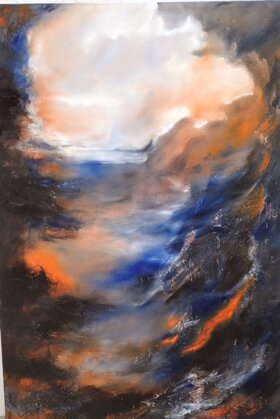
The Glass VeniceOil on Canvas 100 x 150 2018
The Glass Venice
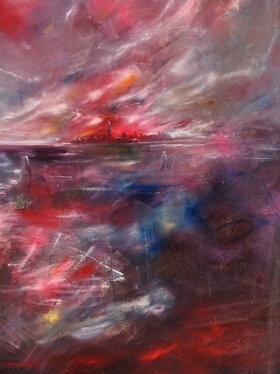
The Mirage at the End of the CaveOil on Canvas and Collage 100 x 150 2018
The Mirage at the End of the Cave
Oil on Canvas 100 x 150 2018
Oil on Canvas and Collage 100 x 150 2018
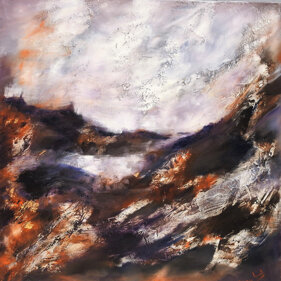
The Ice Mountain
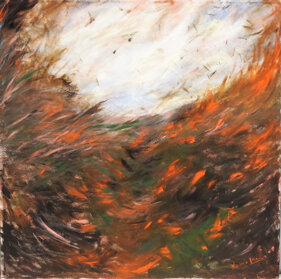
Autumn
oil on canvas cm 150 x 150
Oil on canvas cm 100 x 100 2019
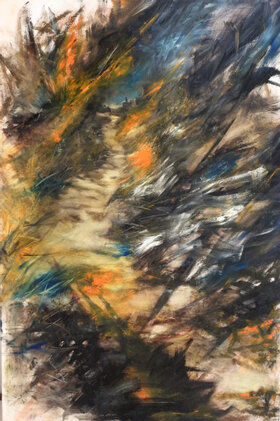
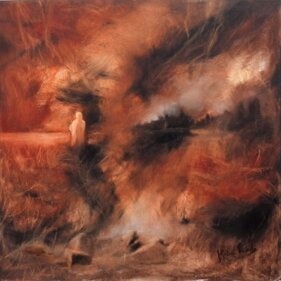
The appearance of New Hope
Oil on Canvas 100 x 100 2019
Mandatory Passage
Oil on Canvas 100 x 150 2018
About his Art
The Critique
The soul's messages in the symbolic works of KARIMA LARABA Thursday, 02 January 2020
by Svjetlana LipanovićThe prestigious Gallery of the Angelica Library hosted from October 2 to 12, in the Eternal City, a splendid exhibition entitled “The Mask and the Vortex” curated by Giuseppe Ussani d’Escobar, an art critic with whom the Algerian artist Karima Laraba presented herself to the Roman public. The works of rare beauty, displayed in the spacious rooms of the Gallery, told through luminous images and enigmatic installations the symbolic universe created by the painter, full of hidden meanings.
Born in Algeria, near the sea, already in her happy childhood she discovered her great innate talent for painting. She attended “Les Beaux-Arts d’Alger” to perfect her skills, before beginning to exhibit successfully in her homeland. The second stage of her artistic journey is Paris, the famous Montparnasse district where in her studio she experimented with various painting techniques: oil, acrylic, watercolor, mixed media, freehand drawing, chalk, charcoal, pastels. In addition, she has created countless pictorial decorations using the techniques of fresco and lime painting, or trompe l’oeil. Her creativity has also been expressed in sculptures made of plaster and papier-mâché with the assembly of various sought-after materials. The painter herself defines herself “as a conduit through which inspirations flow, strong emotions that, like a vortex, are transformed into her works.” For her, to create means to breathe, to live, to attentively grasp the beauties and horrors of the world, later immortalized on canvas to convey to viewers a message written in the universal language of art.
The exhibition set up in Rome encloses, like a precious casket, the most representative creations resulting from past experiences and research. Every canvas, every visible sculpture is a story that, through the skillful use of colors, lights, and various materials, speaks to us silently about current, often dramatic themes of contemporary society. The artist, with her sensitivity and imagination, senses the approach of the apocalypse that could destroy our fragile world, the harmony of nature deeply offended by the exploitation and neglect of humankind. A true denunciation is the work that speaks of desolate landscapes where “There is nothing left to fish,” while in another painting, one notices the group of survivors in search of a new world. The sculptures with the perfect, impenetrable faces of white masks are the personification of various hidden evils that devour society. “The Mystery of Janus’s Flowers,” with its two-faced mask, is a strong accusation against rampant consumerism. The mask on one side swallows plastic, while on the opposite side one notices the mouth full of contaminated flowers made from the same material that pollutes nature. The spasmodic search for eternal beauty has materialized in the papier-mâché mask and the biodegradable mannequin entitled “The Obsession with Beauty.” Another disturbing sculpture is the mannequin surrounded by books with features hidden by gauze, the symbol of humanity on its knees before an ever-increasing cultural decay. “The Angel of Peace” can be glimpsed in the white background as a hint of hope, similar to the lights that are always present even in the darkest paintings and with the most complex themes, because the light of hope, according to the painter, must never go out—never! With these symbolic installations, the painter approaches the Pop Art represented by George Segal and the American Funk Art of which Edward Kienholz is one of the leading exponents, as well as Joseph Beuys
One of the fascinating characteristics in Karima Laraba’s works, besides the exceptional mastery of color, is the light that emanates from within the canvases, creating a rarefied, dreamy atmosphere made of a thousand nuances. Particularly in the landscapes, the paintings recall the great English painter Turner, unsurpassed master of evocative atmospheres. The painter lets herself be swept away by nature, by the power of the elements that dominate it, by the poignant beauty of creation. Thus was born “The Wave,” a hymn to the indomitable power of the sea, “Autumn,” a symphony of leaves swept by the wind, “Union of Strength in Light,” a tribute to Queen Nature. Algeria, “the locus amoenus,” is represented with the seashore, from which the artist set out to first land in the French capital and later in Venice, portrayed in the painting “Venice in Glass.” The irresistible call of water, a regenerating, enveloping, calming element with which she feels in symbiosis, led her to the lagoon city where she opened her studio “Myosotis Karima Arte,” a true forge of excellent creations, all to be deciphered. So far, the painter, in addition to exhibiting in her studio, has participated in several Exhibitions and Art Shows, in exhibition spaces around the world:
Consulat Général d’Algérie à Paris “La Baix d’Alger,” “Collective of Algerian Artists” at the United States Embassy in Algeria, in 2000, “Hommage à Edouard Mac Avoy” Maison de la Radio-Peintres Du Spectacle-Association Charles Bassompierre in Paris, “L’autre” Cercle National Des Armées, in Paris in 2009, “Between the Real and the Unreal” Spazio Bianco in 2012, in Venice, from “The Mask and the Vortex” at the Galleria della Biblioteca Angelica, in 2019 in Rome.
The listed exhibitions are visible on the internet:
http:// www.bibliotecaangelica.beni culturali.it/index.php?it/208/archivio-eventi/313/karima-laraba-la-maschera-e-il-vortice
www.cnaparis.com
www.consulat-paris-algerie.fr.
The immense imaginative power, which distinguishes every true artist, combined with talent, preparation, and constant and passionate commitment, will undoubtedly lead Karima Laraba to leave an indelible mark on the world of art, with her soul's messages hidden in her symbolic works.
Il Gazzettino di Venezia Culture & Entertainment Art of Saturday, August 24, 2019
The lagoon journey of the Algerian “Nina”
By Riccardo Petito
"La Nina" is the signature of the Algerian-born artist Karima Laraba, just like the name given to her daughter, at the bottom of a true love letter to the lagoon city that adopted her.
From Karima, also a reflection on the transience of Venice starting from the phenomenon of high water, which reminds us that nothing is eternal, at the risk of Venice's very existence.
An artistic journey that, after numerous successes, including a successful solo exhibition in the city a few years ago, will lead her in October to the Angelica Gallery in Rome, just a few steps from Piazza Navona.
The Breath of Life curated by Giuseppe Ussani D’Escobar, will bring together about 60 works in addition to a couple of
installations. The figurative language coexists with the abstract, fused in a Venetian light.
There is no lack of the element of the masks “Spirits of the elements who watch over, wandering among men,” writes the curator of the exhibition, who adds, “The Venetian Byzantine gold, which emanates fragmented and splintered luminosity, brings before our eyes the golden brightness of the Algerian desert and the magical reflections of the Mediterranean.”
The joyfulness of childhood memories from the homeland merges with “the abstract suggestions of the small dreamy alleys of Venice”
At a very young age she participated in a group exhibition of artists in Algiers, and at twenty-nine she moved to Paris.
A holiday in Italy, about ten years ago, proved to be providential and from the vitality of Naples, where she met some of her fellow natives, the "grand tour" took her to Venice at a difficult time in her life.
The opening of an atelier "Mysotis Karima Arte" in Santa Croce dates back to that time, with the creation of canvases as well as artistic costumes and masks. Then came the closure and the decision to devote herself entirely to art.
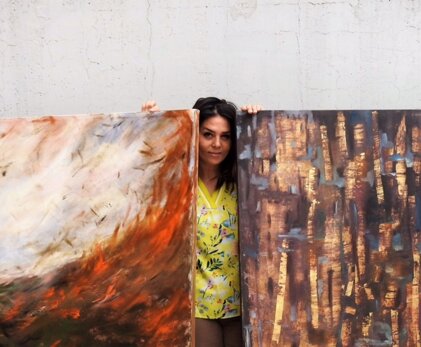
I was born in Algeria in 1973 near the sea.
My grandparents' house was a pied dans l’eau always full of people, where adults and children only met to eat, while in the evening, the aunts would improvise music, and the whole family would stop, it was joy, it was beautiful.
At the age of five I remember making a drawing, with one of my many cousins we took it and threw it into the sea.
That day my cousin said: "Karima, someone will find it, look at it and feel pleasure."
Seventeen years later I participated, with other Algerian artists, in my first exhibition, I was immediately contacted by newspapers and television. People liked my art, a lot. From the shy and withdrawn little girl I was, I was transforming into a young woman, whom many called an artist.
Artist, I almost find myself refusing this word, in reality I just have a gift.
I am a "channel" through which inspiration passes and when the emotion becomes too strong it turns into a work, for me it is something natural, it is like breathing.
At twenty-nine, after some exhibitions in Algeria, life brought me to Paris.
I followed my heart, but it ended badly. Go back to my hometown or stay.
I called my father, who told me: "My advice is to follow your dream, make your name known, what is difficult for many is simple for you, have respect for yourself, do not give in to temptations."
I resumed my studies and continued to exhibit.
Life went on, but what was easy for others, a love, a family, for me seemed impossible. Of course I had friends, but many of them loved nightlife and I soon realized that Paris was not for me.
In 2007 I was lucky enough to come on holiday to Italy.
For me, as an Algerian, Italy was like a beautiful woman for a man.
During my trip I found myself spending a weekend in Naples. It was a coup de foudre. I fell in love with the buildings, the views, which reminded me a lot of my homeland, the people, the shouts, the chaotic hustle and bustle, in short, with life!
Everything was so different from where I lived in Paris, where children never play in the street.
From that year on I started visiting Italy, every time I could: Pisa, Bologna, Rome, Venice.
I swore to myself that I would end my days in Italy, with the person who made me discover it or without!
In 2011 I lost my mother.
It was so difficult and painful to return to my Parisian studio in Montparnasse that I started looking for a new home. There are no words to describe that period of pain. I accepted the advice to take a trip to Sardinia: "to get a change of air" they suggested. I left.
There I did my first scuba dive.
I threw myself into the water, my heart was pounding in my chest, however, as I went down I felt myself dissolve into the liquidity, as if I had always been water, sea. A surreal calm came over me. I took a deep breath as if freed from the weight of suffering and resurfaced.
It was time to live in Italy. But where.
I called some Algerian friends: "You are an artist, you must live in Venice" they told me and so I did.
I found a house in a weekend.
A month later, in November 2012, I filled a truck with the help of a friend and moved from Paris to my new Venetian home.
I called my father who knew nothing: "Dad, I found a house, I'm fine" and he: "In which arrondissement of Paris?" "In Venice in Italy" I said and he replied: "You did well, Italians are serious people, they love family, you have my blessing."
I got the first tax code of my life, my first exhibition and there I met an Algerian craftswoman.
She worked with papier-mâché, I asked her to teach me.
That's how, shortly after, I opened my Venetian atelier "Myosotis Karima Arte" in the Santa Croce district.
In a month I was number one on TripAdvisor. I was happy, customers became friends, even though I spoke very little Italian, Venice had welcomed me with open arms.
It was a great fortune, but an even greater one followed: my daughter Nina. "Pregnant at my age!" I said to myself. She was a gift from the Angels.
The joy was so great that I started writing a book in tribute to the wonderful city that had welcomed me and in tribute to life. Shortly after it was published.
Life's generosity gave me another child and to raise them both I decided to stop working. "The Love of Art" continued to burn and in 2019 brought me to Rome, with a new exhibition at the Galleria della Biblioteca Angelica.
Now I live from this love, immense and indescribable, which envelops my body even when it is without strength and warms my soul. It lights the path of my family, Ninà and Gabì, supports every choice I make and protects me. It is the love from which all my works are born.