
KATARINA ALI - Yugoslavia
Contacts: katarina.alivojvodic@gmail.com
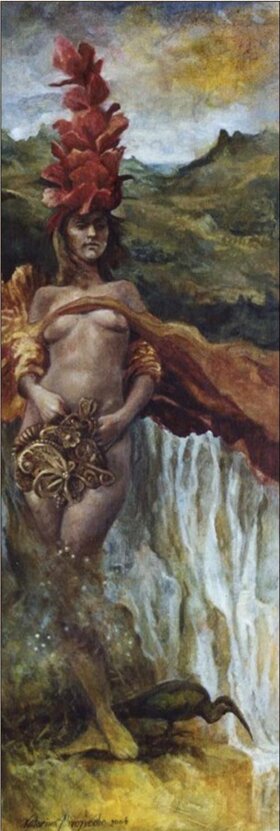
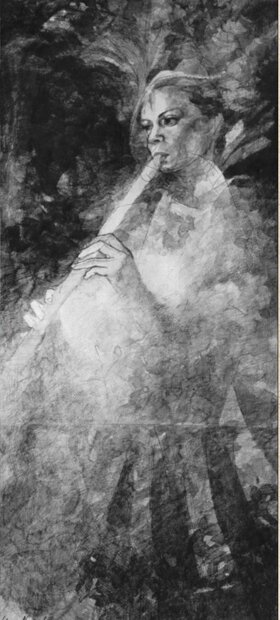
Jelena
China on paper cm 35 x 70
Water and fire
oil on canvas board 20 x 60 cm
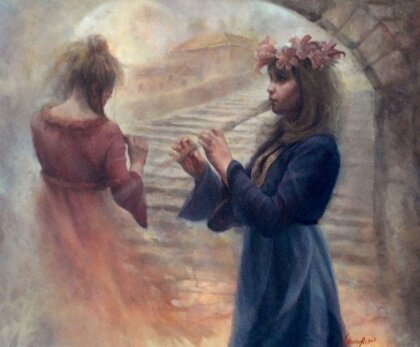
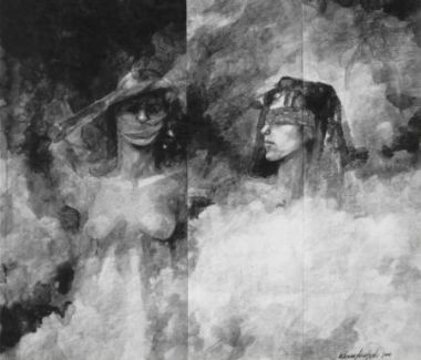
The Annunciation
The riddle
oil on canvas 50 x 60 cm
pencil on cardboard
Lovely sighs
Terpsichore
oil on canvas 40 x 60 cm
oil on canvas cm 50 x 70
About her Art
Katarina Ali was born in 1973 in Zemun, Yugoslavia.
In 1993 she graduated in Industrial Design from the School of Design in Belgrade and in 1999 she graduated in Graphic Design from the Academy of Fine Arts in Belgrade.
At the same time, she attended private lessons in the art studios of some masters such as Acc. Pavle Nik, Zeljko Djurovic, Zeljko Tonsic, where she learned the techniques of painting, sculpture, drawing, and engraving.
The artist has participated in numerous group exhibitions and shows in Italy and Yugoslavia. She won first prize in the drawing competition organized by the “B. Stamenkovic” gallery in Belgrade. Her works are found in private collections in Serbia, Italy, France, Spain, and Greece.
Among her solo exhibitions, we recall those of:
1999 “Akord” Gallery in Belgrade (Yugoslavia)
1999 “Hadzi Ruvim” Gallery in Lajkovac (Yugoslavia)
2001 Pro loco “Artemisia” in Castroreale
2001 Municipal Gallery of Milazzo
2002 “Helios” Gallery in Rome
2002 at the “Green Manors” exhibition space in Castroreale
2004 “Il Gabbiano” Gallery in Messina
2005 “Italarte” Gallery in Rome
The artist has lived in Italy since 2000, and since 2001 has run a painting and drawing school.
The Critique
Floating atmospheres and magical visions
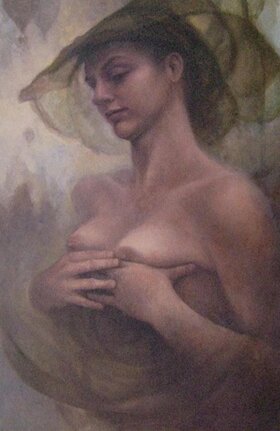
Dreamlike and fairytale atmospheres, “Gothic-like” and reminiscent of the art of the Pre-Raphaelites, pervade the works of the young Yugoslav artist Katarina Ali.
Her paintings are immersed in a magical, floating and silent, ethereal and sensual dimension.
Small sparkling lights similar to fireflies accompany Katarina’s characters, lighting their way as they search for their own destiny.
The artist’s poetics are encapsulated in a text by the poet and writer (as well as diplomat and ambassador) Jovan Ducic, “The Treasure of Tsar Radovan.” Ducic, influenced by the Parnassians and French Symbolists, wrote poems and lyrical prose with which he introduced the taste for “art for art’s sake” into Serbian literary production.
In particular, an excerpt from the text that speaks of Tsar Radovan allows us to immerse ourselves in the magical atmosphere of Katarina’s works:
“…Moses spoke of it when he followed the word of God and Caesar when he crossed the Rubicon and Columbus when he entrusted his sails to the wind that carried him to a land he knew nothing about. This treasure is also sought by the astronomer who observes the star clouds and the botanist who seeks the secret of fertilization in the heart of a little flower and the priest who restores faith in the hearts of unbelievers. All people search, because all are mad. The blood of all has infected Tsar Radovan who lives in the grass and in the water, a mighty tsar who passes in the sky like a cloud full of lightning and passes in the sea like a burning ship…”
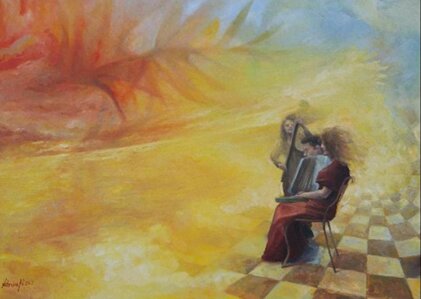
Katarina’s images are rich in symbolic references. Music is imprisoned in the instruments played by beings that are a combination of men, fairies, and elves. The resulting images are evocations that taste of dream and myth, gentle and light, stylistically very elegant and refined.
Iridescent clouds that brush the ground surround the protagonists of the 2006 diptych, in which two flutists are found within a medieval landscape, accompanied by colorful tropical fish, in a natural environment where water, sky, and earth merge.
The evocative power of music is also present in other works, where there is almost always a young woman playing a wind instrument or a kind of mandolin, immersed in a rarefied atmosphere and wrapped in clouds. The woman is always the protagonist in Katarina’s works, a woman who is alternately a sorceress, Salome, Venus, or fairy, always placed in the foreground and surrounded by an aura of mystery. A woman accompanied by small sparks, who reveals herself before our eyes but of whom we will never know everything.
The grace and symbolism of certain figures hint at Art Nouveau and Art Deco reminiscences, even if the strength of Katarina’s figures is far from the representation of beauty for its own sake. The connection with nature, with the sky and with water, which usually represents the Danube River dear to her, makes her characters figures of connection between our world and an ideal and exciting world, a world capable of enveloping our senses and carrying us away in ecstasy, far from the reality that surrounds us and often saddens us.
But what are Katarina’s characters searching for? Is their flute perhaps a call to someone or something? In fact, they seem to want to evoke something greater, perhaps they too are searching for the treasure of Tsar Radovan. What is certain is that her paintings are fantastic visions capable of transporting us far away in time and space.
In the landscapes, nature is the undisputed protagonist and the depictions become more real, without losing the charm that surrounds the other works.
Cinzia Folcarelli