
NABIL - Syria
Contacts: nabil.al-zein@libero.it
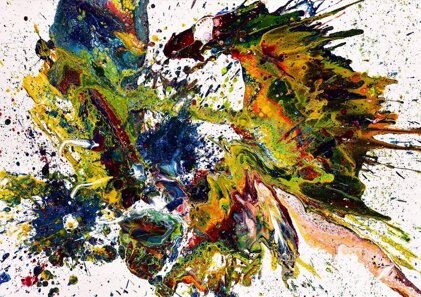
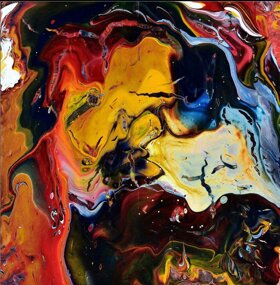
Dynamic art 14
Dynamic art 53
acrylic on medium-density cm 25 x 25
acrylic on canvas cm 50 x 70
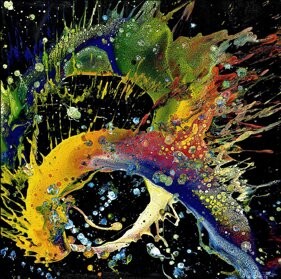
Dynamic art 71
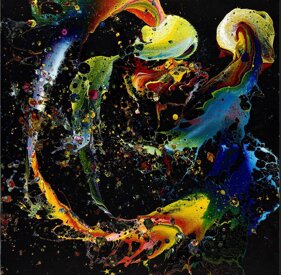
Dymamicart 59
acrylic on canvas cm 60 x 60
acrylic on canvas cm 60 x 60
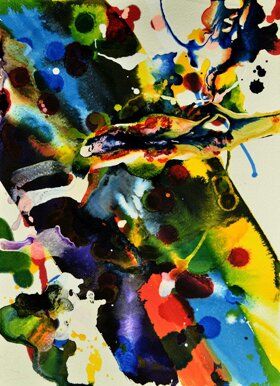
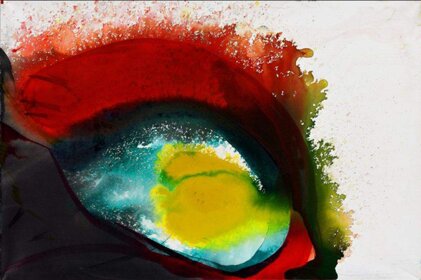
Symphony 5
Fantasy 6
acrylic on canvas cm 50 x 70
acrylic on paper cm 28 x 38
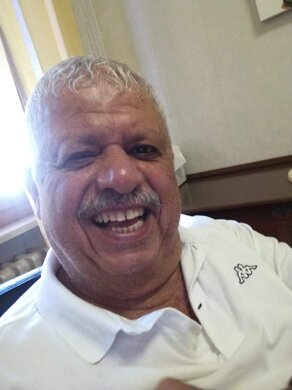
His Biography
My art between originality and experimentation
My masters:
There have been many who have influenced my artistic path, even indirectly. A tortuous but straight path in its intent, as there are various ways, all united by a common denominator of research, experimentation, originality, and love for color. All this is evident not only in the methods but also in the materials, due to their physical-chemical characteristics, obtaining effects of attraction and repulsion, also causing the aging effect.
My first master was Enrico Baj, who believes that the genius and spontaneity of the apprentice should not be sacrificed in the attempt to rigidly follow the stages of the classical study of art, thus restraining them.
I dove into watercolors, which I am still in love with for their transparency, sincerity, and freedom (so much so that from the beginning I started to watercolor even acrylics), but I also produced works with India ink, metallic colors, and the airbrush.
My journey has crossed almost all schools of painting: from iconic, to impressionist, expressionist and conceptual, abstract, collage, arte povera, gestural, sculpture, photography, video art, passing through installations up to fluid painting (pouring) modified into my Dynamic Art. And here emerges my second master, Michelangelo Pistoletto, who, not wanting to be labeled with a distinctive stamp, freely hopped about making works that run indistinctly from one school to another, if not even putting them together in the same work.
My approach and total involvement with the Iperspazialisti made me admire, besides Lucio Fontana, also Agostino Bonalumi, Turi Simeti, Enrico Castellani, and Piero Dorazio, without forgetting Emilio Scannavini and Roberto Crippa but also Georges Mathieu, Alberto Burri, Victor Vasarely, Hans Hurting, Arnaldo Pomodoro from whom I got the obsession with the sphere, its mobility, and what it hides inside itself.
But the one who truly struck me was Paul Jenkins, because, as a lover of watercolor, from the very early years I would watercolor everything I found in terms of materials, recently pushing myself to further develop this technique in my latest research entitled “The Turning Point” and more specifically in “Melody.”
My leap from the third dimension of space to the fourth of time (sealed in my proposal of the “Manifesto of the Fourth Dimension of Time”), was based on the realization that Space and Time are a single entity, inseparable Siamese twins but only artificially and arbitrarily separated, which unequivocally influence each other.
Following a reflection in which I tried to understand how one dimension acts and influences the other and who is the actor behind all this, I came to identify it as Movement, the only sign of life according to our Leonardo (and here I speak generically of movement and not of the speed admired at the time by the Futurists). A perpetual movement, whether slow, fast, or even very fast, like what we constantly observe in cosmic space, where we continuously witness the birth but also the death of planets, stars, or even galaxies, which are swallowed by a giant black hole or exploded and reduced to infinitesimal fragments that scatter in the cosmic void while once they shone, ran, and bounced with extraordinary vitality, which has always fascinated us in cosmic life and it was precisely in this way that my Dynamic Art was born.
THE TURNING POINT
At a certain point I wanted to go over my entire artistic journey again with all its stages, but with a new key to interpretation, and it was an experimental period called “P.T.D.T.” (abbreviation of “Technical Transmission Tests,” a title borrowed from the beginning of color TV) from which four lines emerged: “Harmony” (acrylic spatula on canvas), “Melody” (fluidified acrylic on fabric), “Fantasy” (fluidified acrylic on paper), “Symphony” (fluidified acrylic on canvas).
Art is harmony, ingenuity, originality, and research.
PERSONAL:
2014:
– Pescara: Mediamuseum
– Pescara: Spazio He5
– Civitanova M. (MC): Batik Café
– Tolentino (MC): Art Gallery “La Cornice”
2010:
S. Paolo di Iesi (AN): municipal spaces
2009:
Serrapetrona (MC): Caburro Gallery
2007:
Monte S. Giusto (MC): The banquet of “Il Fauno”
2006:
– Morrovalle (MC): Municipal Museum of Palazzo Lazzarini
– Trodica di Morrovalle (MC): Caffè Spreca
2005:
– Macerata: Antichi Forni Gallery
– Montegranaro (AP): “La Perla” Theater
COLLECTIVE:
• Italy: in addition to group exhibitions in various cities, present at the international art fairs of Bari, Florence, Forlì, Genoa, Padua, and Reggio Emilia and at the Ar[t]cevia International Art Festival.
• France: Paris (Gallery “Atelier Gustave”), St. Paul de Vence (Gallery of the Hotel de Charme).
• Great Britain: Islington (August Art’s Gallery Space).
• Slovakia: Modra (Merum Gallery).
PERMANENTLY AT THE ART GALLERIES:
Azzolino Art Gallery (Rome);
Art Gallery “La Cornice” (Tolentino – MC);
STUDIO 2B BOGGI ARTE (Bergamo).
PUBLIC AND PRIVATE COLLECTIONS:
Pescara: MediaMuseum;
Nocciano (PE): Museum of the Arts;
Sulmona (AQ): Municipal Gallery of Modern and Contemporary Art;
Rome: Studio Soligo;
Falconara Marittima (AN): Municipal museum;
Morrovalle (MC): Municipal Museum;
Pianella (PE): Civic Museum;
San Martino Sulla Marrucina (CH): Pirolo House Museum;
Serrapetrona (MC): Museum of Sacred Art;
Torreglia (PD): FLEXUS archive of the Sinestetico Group;
Cesano Maderno (MI): Fiorenzo Barindelli Collection;
Benevento: Museum of Contemporary Art of the Witches SAMAC;
Corato (BA): State High School “Alfredo Oriani”;
Palazzo Pignano (CR): Municipal Antiquarium;
Wandering venue: An entire museum on one wall.
SELECTED PUBLICATIONS:
– History of Contemporary Art – 40s** Volume II – by Giorgio Di Genova;
– Catalogue of the Civic Art Gallery of Modern and Contemporary Art Sulmona by Cosimo Savastano – ed. Verdone.
– A comprehensive proposal, presentation of the catalog of the XXXVII Sulmona Prize curated by Carlo Fabrizio Carli;
– Conversations between Art and Audience (2010) by Roberta D’Intinosante;
– The hyperfantastic Hyperspatialism of Nabil, from Albatros (VIII, n. 76, March 2008) by Maurizio Vitiello;
– The Hyperspatialist Orbits, (October 2008) by Leo Strozzieri;
– The daily jolts of the Hyperspatialist Nabil Al-Zein, from Il quotidiano di Caserta (January 4, 2007) by Maurizio Vitiello;
– Contemporary Research VII national exhibition of visual arts city of Pianella (2007) by Leo Strozzieri;
– The work of Nabil Al-Zein, from Albatros (VII, no. 63, January 2007) by Maurizio Vitiello;
– Iperspazialista Movement – itinerary of art beyond (2006) by Leo Strozzieri;
– “Nabil Al-Zein between East and West – space becomes a psychic phenomenon” curated by Ivan D’Alberto – Paparini Editore 2014 (online version:https://www.sfogliami.it/flip.asp?sc=chfukcjs8dt7j4lvksg0nr9k0jmruub1&ID=116996 );
– “Dynamic Art” – curated by Maurizio Vitiello – Paparini Editore 2018.
OTHER PUBLICATIONS:
• “ACCA” Modern Art Yearbook ed. 2006 and 2007;
• “Art Diary Italia” ed. 2007, 2008.2009, 2010.2011, 2012.2013:
• “Art Diary International” ed. 2007, 2008, 2009, 2010, 2011, 2012, 2013;
• “Arte Florence 2008”;
• “Arte Genova” 2008 and 2010;
• “Arte Padova” 2007 and 2008;
• “Arte Reggio Emilia 2007”;
• “AR[t]CEVIA International Art Festival ” – 2009/2010/2011/2012/2013;
• “International Encyclopedic Dictionary of Modern and Contemporary Art 2007”;
• “AT THE COURT OF TRIUMPHS The Tarot from the Origin to the Third Millennium: The Tarot Museum” vol. 1 – Hermatena 2009;
• “Art at School IN CARTIS – a conquered paper” curated by Leonardo Faccioli, Massimo Pompeo, Chiara Strozzieri – IL LEVANTE editions 2009;
• “Art at school SEGNIXLIBRI – rectangles of love” curated by Leonardo Faccioli, Massimo Pompeo – IL LEVANTE editions – October 2009;
• “Borders – Catalogue of the 8th International Painting Competition City of Laives” – 2006;
• “Iperspazialist Movement – itinerary of art beyond” by Leo Strozzieri – Artechiara 2006;
• “40 years of avant-garde of Studio 2B 1967 – 2007” curated by Lorenzo Boggi;
• “XXXV/ XXXVI / XXXVII /XXXVII /XXXIX/ XL / XLI/ XLII/ XLIII/ XLIV /XLV / XLVII / Sulmona Prize” organized by the Art and Culture Circle “Il Quadrivio” of Sulmona;
• “Leo Strozzieri and the Hyperspatialist Orbits” edited by Chiara Strozzieri – Artechiara 2008;
• “1000 artists at the Palace – showcase of contemporary art” curated by Luciano Caramel – Editoriale Giorgio Mondadori;
• “Art and the Web – towards new forms of creative expression” – by Simone Fappanni – immagin@aria EDITRICE 2008;
• “Fifty artists for the children of Cameroon” – exhibition/auction catalogue Kiwanis Club of Macerata – February 2011;
• “Ambientarte III” curated by Massimo Nicotra and Sasha Zelenkevich – Artistic 6 Publishing Company, Novecento Cultural Association (Gaeta) – 2012;
• “The fourth dimension in Nabil's art” by Nazzareno Trevisani – curated by Vendere Quadri – Art Intermediaries – 2013
http://www.venderequadri.it/wp-content/uploads/2013/12/CatalogoNabil.pdf
• “March… stormy weather TEMPORALISM” – Critical presentation by Ivan D’Alberto – curated by CGroup & DonQuijote – Paparini Editore (March 2014);
• PESCARART 2014 – Pescara Art Evolution – catalogue of the 5th edition “Pescarart” – July 2014;
• “Harmonies – Emotions of notes in color” – Art Catalog “Harmonies” – July 2017 (online version at:https://goo.gl/z3teBZ );
• “Art Paths in Italy 2015” curated by Giorgio Di Genova and Enzo La Pera;
• “Festival of Hyperspatialism”– Corporazione Sancti Martini – 2018;
• “StegArti two thousand eighteen – Arco di Traiano Award” by Eraldo Vinciguerra – January 2018.
• “Art in Art” – 3rd edition 2019 – Fioroni graphics
MAGAZINES, NEWSPAPERS, MEDIA:
Abruzzo today
Albatross
Art Journal
Forward!
Corriere Adriatico
Abruzzo News
Culture news
Exibart on paper
The Brigand
The Center
Il Messaggero
Il Resto del Carlino
The Caserta Daily
The Weather
Italia Evening
The Illustrated Aperitif
The new Ferrara
Latina today
The Oracle – the Hour of Abruzzo
Napoli.com the online daily newspaper
Positano news
Meeting Point
Ravello Magazine
Rebirth
Curtain
Misena Voice
TG 1
TG 3 Marche
TG 3 Abruzzo
Onda TV
Sky TG24
Roma uno – Colors
Local networks (Local networks)
The Critique
"EMOTIONAL TEARS"
by Maurizio Vitiello
I've known Nabil Al-Zein for a long time, almost twenty years.
I meet him everywhere, from the “Sulmona Prize” to the “Arte Fiera” in Bologna, from Abruzzo to Calabria.
I hiss Arabic greetings, but my Neapolitan tongue adds sophisticated irony and he laughs, because he understands there is affection.
From geometric segments to well-regulated agglutinations he has shifted, and now he brings forth echoes of vivid chromaticism, as well as the impact of gestures in broader, more breathy compositions.
The artist relates coloristic fans in a climate of gestures.
His chromatic crossings are pushed to claim bursts of life.
The chosen linguistic solution allows him to accentuate speed and immediate conclusions.
Hints, multiple suggestions cover the distinctly informal material drive and fresh propulsive vitality can be noticed.
It is, fundamentally, a painting that determines intensity of character and caliber.
Capable reliefs transfigure the emotional impact and the visual field is marked by sign-like pronunciations.
In his cadenced drafts he interprets calculated expansions.
Transparent and extreme notations streaked with free informal fields circulate, letting iridescent chromaticisms slip by with rolling breaths; and a sense of the soul is pinned down.
It is not just an exercise in decidedly dynamic painting, but above all, a succession of psychological paths.
Among abbreviations, augmentations, compelling flows, highly sensitive pulsations move.
In short, traces, integrations, and rapid chromatic successions pursue a plasmatic rhythm of tonal variations and luminous sources.
Substantial intentions load beating feelings.
The artist studies, regulates, expresses surpassings to go beyond the informal code modulated by a gestural force, which becomes the apex of propositions.
Nabil Al-Zein moves passionate transports and recounts in a thousand versions a fabric of reasoned composite layers.
His emotional passages aim to substantiate observations of reality in an expressionistic key of informal cut and, at the same time, to associate and render exciting energies that run through his soul.
Maurizio Vitiello
Rome, Naples, Procida, June 2018
***
The variety of Nabil Al-Zein's works, so diverse and multifaceted even in their languages, is more a sign of intellectual vitality and poetic sensitivity than of restlessness or uncertainty. It demonstrates the variety of stimuli from which they originate, and above all, gives an idea of the conception this author has of art: an all-encompassing idea that corresponds to living in its complexity; to the consequentiality and participation it entails.
Abstraction is congenial to the artist, it is in his DNA, and moreover, it is part of a culture of origin (even though Nabil took his first steps in art lingering on the figure and on a northwestern avant-garde culture) of which he claims and emphasizes the sense of the limitless. In his material and object-based creations, the infinite and the infinitesimal meet in a logical combination that encompasses the universal and the cosmic. And spatial attention is inscribed within these parameters, in relation to time, guided by light. His idea of space and hyperspace finds light as the revealer of truth and life.
The sense of freedom brought him closer to art.
Reality is observed with an analytical eye. There is a kind of perceptive analysis obtained by contrast, almost obscuring the evidence of forms in favor of their meaning. One experiences the perception of forms that present themselves as symbols or as elements of a fundamental conceptual apparatus. A panicky sense that investigates the particular and the episodic to express an irrepressible desire for the absolute.
Fundamentally, Nabil Al-Zein's research is based on multimedia; it involves techniques but also the body and action. The observer is called to participate actively and everything is aimed at positivity and sharing: the most effective way to communicate.
This use of multimedia is a direct consequence of the sense of freedom and boundlessness previously mentioned; in it, in the multimedia potential, Nabil experiments with and points to one of the most characteristic and innovative features of contemporary art.
In other words…
A totalizing conception of art, that of Nabil Al-Zein, both in linguistic terms and in terms of content (of poetics). Linguistically, he makes use of widespread eclecticism, practicing various techniques that involve painting, sculpture, video art, performance, installation, etc., and the creation of an absolutely boundless typology of forms or non-forms. On the thematic side, his is an art completely aligned with the current globalized climate, with particular attention to ethnic and geographic aspects; while not denying tradition, it unequivocally sides with a total liberalization of art and thus with its continuous updating.
Interesting is his paired and simultaneous involvement in both theoretical and experimental senses. His hyperspatialist experience and, more recently, those of temporalism of which he can claim paternity, demonstrate that his universalistic idea of art does not recognize the distinction, or recognizes as improperly restrictive, the terms of time and space.
His reflection also involves the art system today, analyzing it critically by highlighting its distortions and constraints.
More than a conceptual art, Nabil pursues a mental dimension of art; by making them his own, he examines the distinction between space and time, moving towards a metaphysical or "fourth" dimension).
Since it is visual art, he prefers to express himself through those forms or techniques or procedures that the materials used tautologically suggest. An experimental, innovative art that spontaneously also recalls the Middle Eastern art of his country of origin.
His idea of citizenship refers to Mediterranean culture.
Temporalism can also correspond to a concept of temporariness: "having its time", in the sense that every thing, idea or work has its own time. A dynamic conception of continuous change and evolution.
The fourth dimension to which Nabil frequently refers is not a concept that can be scientifically defined, but rather a "beyond" to which art must necessarily aspire; a transcendence of mere physicality both in a temporal and spatial sense as well as in a metaphysical sense. (Lucio Del Gobbo 2014)
***