
PAOLO VITERBINI - Italy
Contacts: paoloviterbini@gmail.com
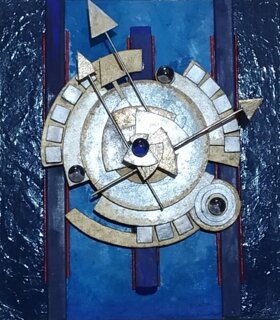
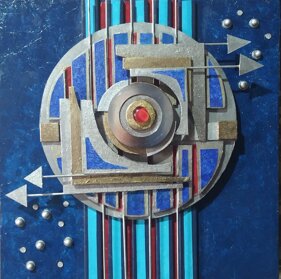
Lunar 5
Lunar 1
paint-sculpture on board, cm 30 x 30 x 5 2021
pittoscultura cm 40 x 30 2021
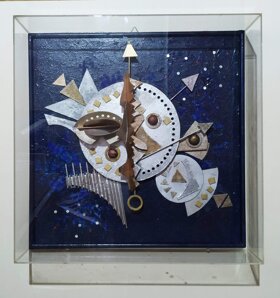
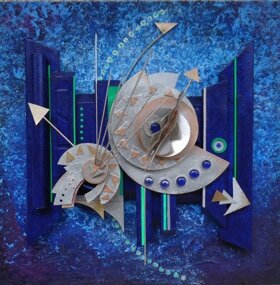
PV - Traces of the green light
Lunatic moon
paint-sculpture cm 60 x 60 x 16 2018
pittosculpture in case cm 40 x 40 x 8 2021
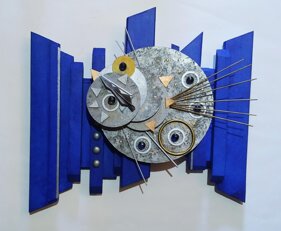
The light of the moon - wall sculpture
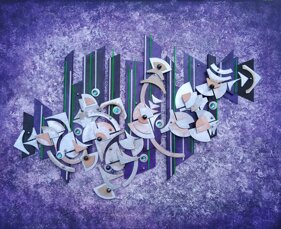
The city that walks
slats, cut-out shapes, glass drops, cm 45 x 50 x 16
mixed media on canvas CM 80 X 100 X 6 2015
On his Art
Paolo Viterbini was born in 1946 in Castel Gandolfo, in the province of Rome.
From his encounter with Eduardo Palumbo, a Neapolitan artist active in Rome, he reorganized his painting following the lessons of Monet, Cezanne, and the Futurists, who in his research journey would become an important point of reference.
He attended the Free School of Nude at the Academy of Fine Arts in Rome, following the courses of Giulio Turcato.
With the Dante Alighieri Society, founded to promote Italian culture abroad, he exhibited at the Italian Consulate in Miami, in Croatia and Slovenia, and also exhibited in New York, Hong Kong, and London at the Italian Cultural Institute.
In Italy, in Rome, Milan, Lecce, Naples, Terni, Ascoli Piceno, Messina, Reggio Calabria, Padua, Benevento, Lecce... and in many other cities.
Among the various publications, he is present in the “History of Italian Art of the 20th Century, Generations of the Forties” edited by Giorgio Di Genova, Bora editions.
Since the early nineties, he has been painting the urban landscape, rendering daytime and nighttime visual memories of a metropolis seen from above through a personal pictographic lexicon made up of curves, dots, and lines of topographic images.
His metropolitan landscapes are also expressed in the form of horizontal sculpture, supported by the need to seek volume otherwise impossible in the two-dimensional language of painting.
As president of the Artinarte Cultural Association, he has organized several exhibitions, including two editions of “Generazioni a confronto” 2015, 2017 curated by Giorgio Di Genova, in 2018 “Ritmi e cromie delle acque” curated by Laura Turco Liveri, and in 2019 “Mater mediterranea” curated by Rosario Sprovieri.
Recent exhibitions:
2020 - Rome, “Quintetto d’arte” curated by Giorgio Di Genova and Carla Guidi;
2020 – Rome Quadrarum Art Gallery, “Visuali urbane” curated by Fabrizio Federici;
2019 – Velletri, RM, Diocesan Museum, “Leonardo Spirito Infinito” curated by Claudia Zaccagnini;
2018 – Rome, Islamic Center of Rome, “Mater mediterranea”, curated by Rosario Sprovieri;
2018 – Frosinone, “Biennale of Contemporary Art”, Exhibition halls of the municipal villa, (first prize for three-dimensional research, curated by Alfio Borghese)
2018 – Rome, , “Rhythms and Colors of the Waters”, Former Paper Mill of the Appia Antica Park curated by Laura Turco Liveri;
2018 - Naples, “Dialogue between Generations”, Castel dell’Ovo, curated by Simona Pasquali;
2017 – Naples, “Tangible Signs”, Spazio Martucci Gallery, by Simona Pasquali;
2017 – Benevento, Arte Studio Gallery, Forms and Colors, presentation by Leo Strozzieri, curated by Enzo Le Pera
2017 - Marino, “Mediterranean Chromatisms”, Umberto Mastroianni Civic Museum, curated by Maurizio Vitiello
2017 – Grottaferrata (RM), “Generazioni a Confronto II edition”, Ancient printing house of the Abbey of St. Nilo, curated by Giorgio Di Genova;
2017 – Sulmona (AQ), Sulmona Prize
2016 – Corigliano Calabro (CS), “Periscope on Art in Italy”, curated by Enzo Le Pera, Special Mention
2016 – Benevento, BENEBIENNALE, 1st place in the Lifetime Achievement Award
2016 – Castel d’Ario (MN), “Artists for Nuvolari”, Sartori House Museum
2015 – Genzano di Roma, “Generazioni a Confronto I edition” curated by Giorgio Di Genova, Sforza Cesarini Palace
2015 – Monterotondo (RM), solo exhibition, “Mediterranean Abstractions”, Campioli Gallery
2015 – Albano Laziale (RM), solo exhibition, “Visions and Views” Mario Antonacci Civic Museum, presentation by Aldo Onorati;
2013 – Rome – 2nd sculpture prize, International Academy of Modern Art
2013 – Floridia, (SI), First Contemporary Art Review, at the MUDAC Civic Museum of Contemporary Art;
They have written about him
Vittorio Esposito, Gastone Biggi, Vito Apuleo, Gerardo De Simone, Carlo Grassi, Mariano Apa, Barbara Vinciguerra, Luigi Tallarico, Silvestro Nicodemi, Gabriele Simongini, Gianfranco Ferroni, Robertomaria Siena, Carlo Fabrizio Carli, Cristina Belloni, Francesco Petrucci, Elena Di Raddo, Giovanni Cerri, Stefania Severi, Biagio Cacciola, Franco Campegiani, Roberto Lucifero, Francesca Gianna, Nuccia Micalizzi, Giorgio Di Genova, Dante Maffia, Daniela Vaccher Boldini, Alberto Magistri, Maria Cristina Vincenti, Michele Miulli, Rosaria Laura Ruggiero, Antonio Mucciccio, Alessandro Bedetti, Aldo Onorati, Adele Scarpellia, Carla d’Aquino Mineo, Leo Strozzieri, Maurizio Vitiello, Simona Pasquali, Rosario Mazzella, Laura Turco Liveri, Rosario Sprovieri, Claudia Zaccagnini, Maurizio Pochesci, Fabrizio Federici.
The Critique
2020 - Maurizio Pochesci; QuadraRum Art Gallery, Rome
Urban visions
…In his works, he occupies the pictorial and sculptural space through the presence of fragmenting elements that reconstruct the images according to an almost metaphysical vision, from which solutions characterized by lightness and dynamism emerge.
The geometries expressed in the shapes of squares, parallels, and circles provide the rigorous vision of the works, where the predominance of lines and curves become bearers of messages that are humanly engaging…
2020 - Fabrizio Federici; QuadraRum Art Gallery, Rome
Urban visions
P. V., in an imaginary journey painted in blue spaces, travels between earth and sky along the paths of a renewed urban landscape; now redesigned in the visions of urban maps, now glimpsed through ideal passages that transform reality into solutions created by him.
2019 - Claudia Zaccagnini, Diocesan Museum of Velletri, RM
Leonardo infinite spirit
He composes with geometric rigor and entrusts his idea of urban life to the sharp profiles of the material and the iridescent reflections of the surface. He develops a stratigraphy of concatenation, a subtle allusion to our social living.
2019 – Rosario Sprovieri; International Islamic Center of Rome.
Mater mediterranea
They are the cities of the next millennium, born spontaneously, they are the landscapes that emerged from the fertility of a capable artist's mind.
Lines, ellipses, concentric circles, tangents and secants, maps of new lands, spaces harmonized for the people of the future. Signs of a new speaking architecture, these are the cities for the community that will inhabit the time of tomorrow. Metropolises are outlined, resembling inlays and ancient mosaics, embellished, above all, by new stages for existence and new warm lights in favor of peaceful relations among human beings. A concrete enrichment, no longer just cold material infrastructures. Paolo Viterbini, while succumbing to the charm of experience and the chronology of history, and being aware of a multitude of urban reconversions based only on the recovery and safeguarding of the legacy of the past, carries out a most interesting operation. Through his skilled hands, he superbly manages to give shape to his creativity and enrich the features of the canonical urban context, with the integration of modernity and “digital” thought. The artist carries out an operation that revolutionizes and profoundly modifies the historical concept of the city. Now the inhabited area is a global planet, a palette of colors, a world accessible to everyone and from everywhere. There are open squares and a multitude of spaces, and everything encourages sharing and connection of things and people. The territories of future life resemble the worlds first shown by science fiction cinema; densely populated centers with myriads of spires that, even as they rise to pierce the sky, always maintain solid roots in the past.
2018 - Laura Turca Liveri, Antica Cartiera dell’Appia Antica, Artinarte Organization, Rome
Rhythms and Colors of the Waters
Lyrical mechanisms, one could call the recent tendency in P.V.'s works in which the dusty light, refracted by pointillist brushstrokes and always arranged in force lines parallel to the plane of the painting, projects outward from the wall support, completing the compositional mechanism in the tactile evidence of geometric forms and balanced linear references.
Water, 2018, painting/sculpture on canvas, cm 70x50x5
2018 – Simona Pasquali, Spazio Martucci, Naples
Tangible Signs,
P.V. masterfully integrates painting and sculpture, which intertwine indissolubly.
Purple tale, 2013, painting/sculpture, mixed media on board, cm 45x102x
2018 – Rosario Mazzella, “Spazio Martucci, 56; Naples
Tangible Signs
The work of the artist P.V. struck me for its original and luminous research. It expresses a futuristic dynamic with planes that intersect, creating a rhythm of modulation of sounds, determined by marks and brilliant colors. A simple thought.
Urban mandala, 2015, painting sculpture on board in case, cm 60x60x8
2017 – Giorgio Di Genova, Abbey of San Nilo; Ancient Printing House, Grottaferrata (Rome)
Generations Compared II edition
… proposes a Mannequin re-dressed by his “topographic” interventions in blue. If the mutilations of the mannequin recall the remains of classical sculpture, the re-dressing visually refers to cosmic effects, as if it had fallen to Earth from the cosmos, testifying that there is also classicism in space. …
2017 - Maurizio Vitiello, Umberto Mastroianni Civic Museum, Marino, RM
Mediterranean Chromatisms
P.V. is an artist who sees metropolises as subjects to be investigated, explored, examined, and captured. Since the early nineties, he has painted urban landscapes with particular passion, conveying visual memories of morning and night. His approach to metropolises is always from a "bird's-eye view," almost a gentle flight over furious cities.
Crossings, 2016, acrylic on board, 90x90 cm
He uses a highly personal language, rich in curves, dots, and lines, almost to "shorthand" the topography of places with his related signs. From drawing oblique details, he has come to dimension them with different materials.… These metropolises, which are on their way to becoming, if the pace continues, true megalopolises, fall into a critical dimension with misleading rhythms. Dynamism is a symptom of that modern inflection that has given speed to acquisitions, but also brings existential stress.
The graphic-plastic evidence of these metropolitan visions indicates the troubled systems of urban landscapes, which increasingly point to a difficult anthropization of the territories.