
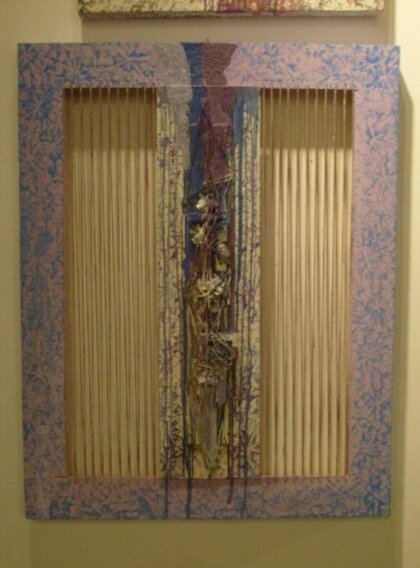
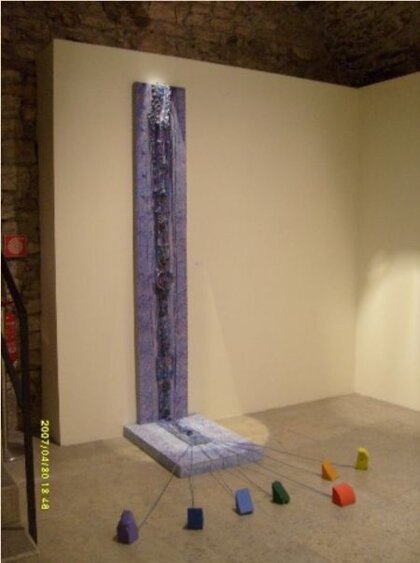
Nature Peace
Through
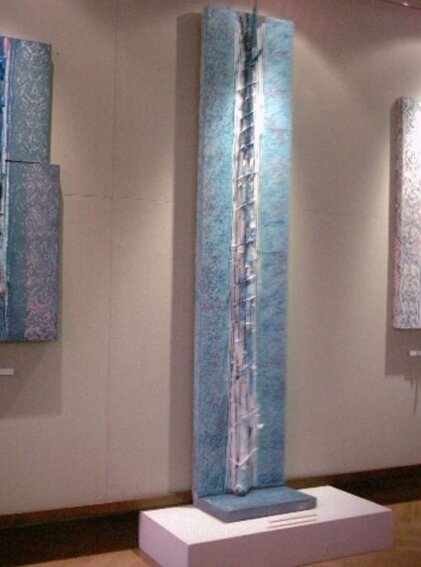
h cm. 250 installation € 1,800
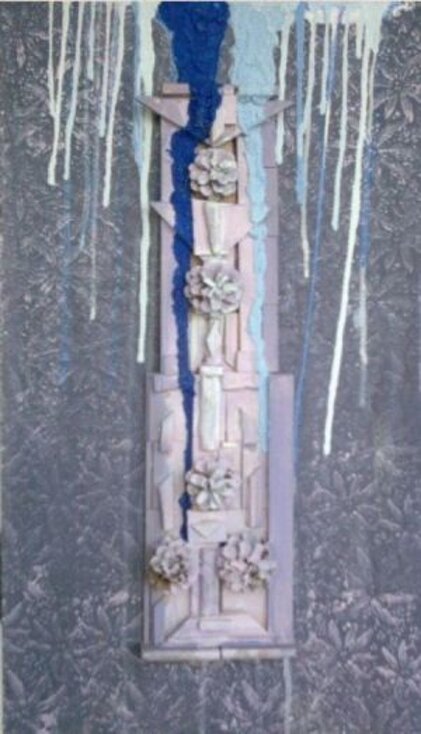
cm. 48x79 mixed media, in relief € 800
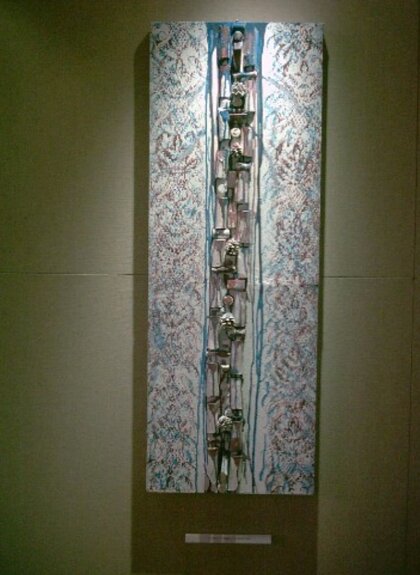
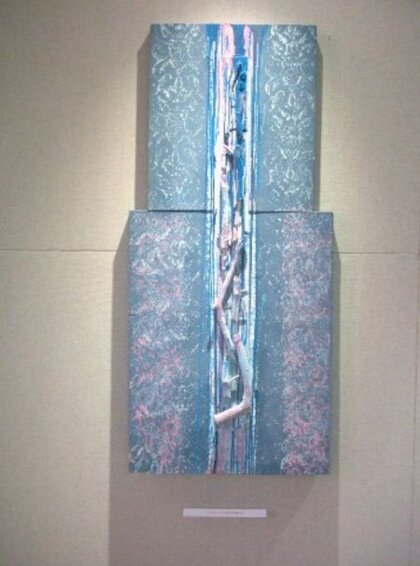
Nature
Totem Natura
cm. 40x110 mixed media in relief € 1,000
cm. 48x109 mixed media in relief € 1,100
In Nature
h cm 209 installation € 1,500
Totem Naturally
mixed media 45 x 79 cm € 900
His Biography
Claudio Cavalieri was born in Trento in 1950, where he lives and works. He graduated from the Trento Art Institute. He has been a teacher of Artistic Education since 1977. He began exhibiting in the 1970s. In 1986, he received a scholarship as a young artist from the Municipality of Trento and came into contact with sculpture in a studio in Faenza. Since 1989, his already material pictorial works have evolved into a marked three-dimensionality; a painter-sculptor always connected to nature and to the recovery of wooden materials, creating high reliefs, sculptures, and installations. He has exhibited in solo and group shows in: Bolzano, Trento, Florence, Milan, Mantua, Padua, Pisa, Livorno, Verona, Treviso, Bologna, Forlì, Reggio Emilia, Avellino, Fano (Ps), Murlo (Si), Correggio (Re), Carpi (Mo), Pontassieve (Fi), Certaldo (Fi), Bressanone (Bz), Piombino (Li), Revere (Mn), Faenza (Ra), Sassuolo (Mo), Brugnato (Sp), Trevi (Pg), Villa di Teolo (Pd), Lastra a Signa (Fi), Cerreto Sannita (Bn), Sesto Fiorentino (Fi), Arcugnano (Vi).
Wuppertal, Hamburg and Templin in Germany, in Vienna in Austria, and in Zalaegerszeg in Hungary.
His Curriculum
Main Exhibitions since 1999
Galleria del Candelaio-Florence-solo
Palazzo Pretorio-Certaldo-Fi
Villa Bellosguardo-Lastra Signe-Fi
Casa Artisti-Tenno-Tn
Palazzo Candelpergher-Nogaredo-Tn
Palazzo Pretorio-Certaldo-Fi
Palazzo Trentini-Trento
Palazzo della Regione-Trento
Centro Gadarte-Florence
Castel Mareccio-Bolzano
Museo della ceramica-Cerreto-Sannita-Bn
Castello di Zumelle-mel-Bl
Società Belle Arti-Verona
Palazzo Pretorio-Certaldo-Fi
Ex fornace Pasquinucci-Capraia Limite-Fi
Centro Civico Rossi-Fano-Ps
Casinò-Arco-Tn
Casa Artisti-Canale di Tenno-Tn
Palazzina Liberty-Trento
Pasticceria Viennese-Trento-Solo
Palazzo Trentini-Trento
Shop Center-Pergine-Tn-solo
Expo SconfinArt Trento
Immagina 6,Expo d’Arte-Reggio Emilia
Piccola galleria Comunale-Bolzano
Galleria Comunale-Bressanone-Bz
Galleria Rettucci-Bolzano
Studio D’Ars-Milan
Galleria Comunale Piombino-Li
Studio D’Ars-Milan
Galleria Web-Art-Treviso
Centro Rosmini-Trento
Centro Civico-Sesto Fiorentino-Fi
Vernice Art Fair-Forlì
Museo del Baraccano-Bologna
Palazzo Trentini-Trento
Galleria Time-Vienna-A
Villa il Mulinaccio-Vaiano-Fi
Galleria De’ Marchi-Bologna
Centro Sinagoga-Zalaegerszeg-H
The Critique
Angelo Sblendore Milan 2004
The artist Cavalieri feels a strong call to matter, which he kneads into color,and in its flows, forming a fascinating combination.
Antonella Raimondo Trento 2004
Painter-sculptor, his experience is mainly oriented towards working with thick pictorial materials, plasters, sands mixed with color. In the last fifteen years, the colors have shifted from the intensity of yellow-green, blue-black, light blue-violet. The current tendency is to cover the entire work
With white, concealing under a glaze natural waste materials taken from the woods, from the rural environment, or from today's consumer society.
Gino Micheli Trento2004
Claudio Cavalieri exhibits twelve small works created with assemblages of various materials recovered over time and in memory from the artist's last four years of activity.
He is a painter and sculptor and is known in the Trentino artists' community as well as outside the province,
for his research whose fundamental references, for years, have been nature and memory in the values of space and time. He creates works and often installations with various materials, covering them with very textured pictorial surfaces and rather bright colors that become landscapes of the
memory, agricultural totems and memories of the past.
Antonella Alban Belluno 2000
Claudio Cavalieri carries out a dual research in painting and sculpture, or rather, his sculpture was an almost natural landing, given that painting had already become a means for
to explore not only the chromatic possibilities, but also the spatial ones. Here then is the landscape at the to-
items made with reclaimed materials already full of history and experience and decontextualized for
to enhance the symbolic meaning of form and pictorial material.
Stefano Zanella Trento 2000
Claudio Cavalieri, with whom we enter the language used by installation: from the investigation perhaps
still predominantly "pictorial" from a few years ago, here evolves towards a more explicit use
of the object out of context, however always leaving an important role to the chromatic intrusion
and sometimes still to the “classic” pictorial intervention.
Renzo Francescotti Trento 1999
….What distinguishes Cavalieri is the strong chromaticism with which he paints the found woods (vivid yellows,
green, purple). The first compositions date back to 1990, relief landscapes with wooden fragments found in nature or recovered from the Alpine rural world. Claudio engages in a dialogue with the environment and
its story, in the dimension of space and time, in a journey alongside objects in the need to sublimate them. In the necessity he felt to go beyond the canvas, Cavalieri creates these
abstract high-reliefs, these colored wooden menhirs, these sculptural icons polarizing mysterious vital energies. As in the three fascinating installations he created for our Exhibition, Visio-
ne….tracce, Tracce and Ex voto. In the first, which reuses an old shutter, from the black background
Watercolor paintings emerge, fragile and luminous, figurative and abstract, to reread memories in filigree. The second relies on pale violet, on the abstract bas-relief on a wooden stele: the third
it has a sequence of small, luminous landscapes, dreamy frames that "pierce" an ancient wooden panel-
cared for by time.
Fiorenzo Degasperi Trento 1999
Claudio Cavalieri, who perceives in the wood the imprint of a powerful life capable of beating
every snare, gathers fragments and rejected shards, lost remnants discarded by the race of civilization.
On them, then, he works a transformation that passes through a special form of respectful love, suspended between a high metaphysical dimension that touches on mystical allusions and a playful evocation
that inspires him to create compositions often similar to mysterious and elementary toys from another world.
In his compositions, therefore, coexist the expressions of a free and virgin spirit such as
that of a child, and the tendency to consider the wooden rejection as an abso-
truly alive. An authentic plastic symbol that carries within itself new, changing, pregnant forms
of latent messages.
Annalisa Orsato Padova 1996
The artistic journey of Claudio Cavalieri, a wood sculptor, begins with the texturization of the two-dimensional image. Painting, through the sensitization of the surface,
approaches three-dimensionality and with the contribution of humble materials—such as reclaimed wood
old constructions-become object-sculpture with a significant contribution of material.
Among all possible materials, wood is chosen; it is a fragment that bears marks on its surface
of the passage of time, recalls the natural element in the veins, in the cracks the bond
with the past.
The wood becomes a vehicle for a message that links it to vegetal assistance-cosmic time and
a message that connects it to the time of man—shorter but not for this reason less perceptible
by the user. Cavalieri believes in his own work, which he presents as a colorful game: here
so complementary colors highlight parts of the structure - purple and yellow - blue and yellow - squil-
lanti as musical counterpoints. The windows, wooden frames, become referents
privileged places where nature and history blend, the bright color stands out from the deep black,
one witnesses a crescendo of light that culminates in yellow. From the black of matter one arrives
to the brightness of thought. As evidence of this, the triangular sculptures become
singular symbols of elevation, of vital impulse towards the spiritual.
Riccarda Turrina Trento 1996
… Claudio Cavalieri presents his most recent research; it is still, however, reclaimed wood,
as an element rich in history and charm, the primary subject with which the artist creates his
sculptures; closely linked to nature, these works propose a path made of references to man for whom they are spokespersons of existential messages, where time becomes a chain and where the
daily fears coincide with the depth of black hues. The color appears like a flash, shaking the surface with beams of sudden light, while overlapping elements or steles pierced by
segments of life, they become silent presences, personifications of inner movements, of needs
spiritual. The fact of nature, its metamorphoses, the rhythmic alternation of days are the central cores of Claudio Cavalieri's poetics, who in his most recent installations tells about himself,
his own experiences by sending signals that are barely perceptible and identifiable in the greater rationalization of forms and of color itself; the joyful elements and even the same ones have disappeared
woods traversed by touches of yellow, no longer speak of children's games, but rather of that moment of joy that inevitably ends up being absorbed by the shades of the night. The artist
then, he seems to have regained a certain ritual dimension in the structuring of his works
, which evoke primitive dances, or ancient instruments for measuring time, and which, placed in open spaces, share the embrace of otherworldly presences.
Lucia Mayer Vicenza 1996
For several years Claudio Cavalieri has shown a strong inclination—which we could call "sentimental"—towards wood, always modulated and composed in evocative ensembles, often
references to ancient symbols. Warm and exceptionally ductile material, wood contains in
You are the source of life and record past, present, and future, bearing on yourself—as a true biological clock—the marks of the passage of time. It is precisely these marks, traces and
wounds of time, which fascinate and capture the artist. A trunk smoothed by water, a broken piece of wood, an old door become protagonists of a new poetic reality, intermediary figures in a dialogue between the artist and the surrounding world. The urgency to express a remedy, to outline
an alternative to our everyday life, makes these works sometimes anguished, sometimes dramatic.
The “chromatic clashes” thus become clashes experienced between reality and desire, between melancholy and hope. The deep black reminds me by association of some figures from ancient mythology, such as
the goddesses of fertility, like the Homeric ocean, like the many figures that populated the realm of the underworld. Black has been and remains a symbol of depth, of chaos, of death. From black to yellow,
Cavalieri seeks in his works a sense of life, indicating the stages of the passage from chaos to
revelation and materializing the need for continuity of life as a will for the future.
SEEING AND NOT SEEING
Notes of knights 2005-06
Relief, materials, matter, and nature are now for me the fundamental elements,
for several years, for the creation of my relief works.
It is a vital sap that continues to create and generate works, sculptures, and installations.
Memory and time are the two mental elements that connect the traces, the fragments, the
objects that I regenerate, creating another new work.
In recent years, a white paint, just as lime once concealed frescoes in the past, veils the wood the
pine cones and splinters and pieces of forest wood creating a three-dimensional work.
The central elements of the work are all tangled, tied together, almost anchored, fixed, and it seems like a game but instead they have become another creation.
It is a creative operation and even the viewer tries to review, to recognize everything in a
creative act on the balance of imagination, a seeing and not seeing where real time and the past become a present, contemporary moment, a memory.
An objective memory, a nature expressed through many waste materials, small fragments
that would be lost but become the core of the work.
My contemporary intervention is to let the very thick and lumpy color of bright shades drip and
often with cool tones that regenerate the work, giving it a new life.
On the background appear decorations created from old rollers that were used to embellish kitchens, living rooms, bedrooms in the 50s/60s, made with very soft colors or in contrast with the
white background, light blue, lilac or violet.
New works as artifacts, works as memory, a world-nature to be saved, to be catalogued, to be
recover, natural collages, creative bricolage, a free creative game, a remembrance of the time spent that is fixed in these new polymaterial works of mine.
Mother Nature who hides and lets herself be rediscovered, a creative, three-dimensional and material discourse
A process that has been going on for years and has become my creative core as an artist, but every time it is new and creative.