
FIORENZO MASCAGNA - Italy
Contacts: info@mascagna.it
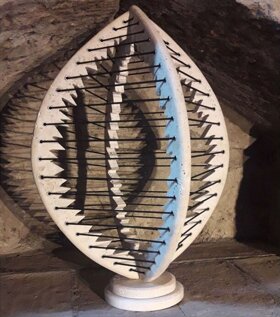
Egg shape
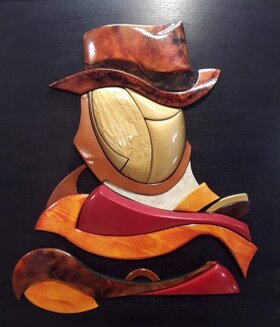
Tribute to Fellini
Travertine and elastic cotton cm 30 x 60 x 30
Polychrome wood and stone cm 58 x 64 x 4
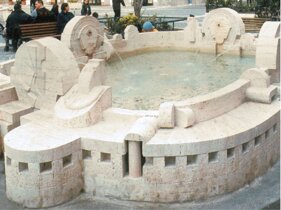
The road
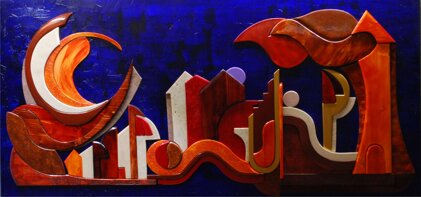
The Four Seasons
Polychrome wood and stone cm 135 x 75 x 4
Travertine cm 800 x 640
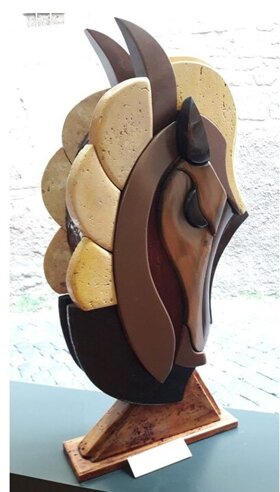
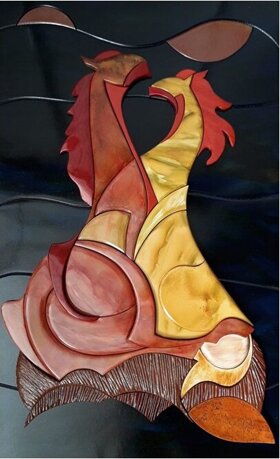
Like horses escaped from the circus
Pride
Polychrome wood and stone cm 70 x 100 x 4
wood and stone cm 30 x 65 x 20
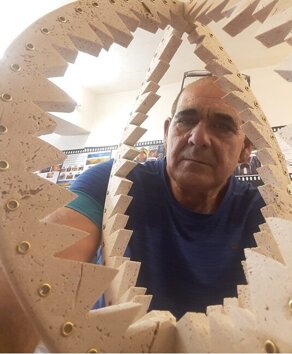
About His Art
I grew up making my own toys, so I quickly learned to give shape to my thoughts. Since then, theory and practice of the object have been part of my life. I was lucky enough to encounter art when it was easy to believe in its promises for the future. Even before studying at the Academy, I started sculpting stones with the few tools I had on the edge of a sawmill. Back then, I thought marble would be the only medium through which I would give shape to my ideas. Clearly, I was wrong.
When wood arrived, I looked at it with suspicion because it didn't have the execution speed of stone. My haste was that of someone who has no fixed points and is constantly searching for that stability we call style. If the Academy of Fine Arts ordered my tumultuous oscillations, it was the artisans and master stonemasons who taught me the craft. I owe the results of my sculptural research to the complementarity of these two worlds.
I was born in 1959 and my artistic path has had its regularity: first the Art Institute and then the Academy where I graduated in sculpture with honors. I never had to do another job to make a living, because at the end of the eighties sculpture and design brought great satisfaction. Even though for a few years I taught Theory of Perception and Psychology of Form in the same school where I had been a student, I can say I never neglected my workbench. The stones went on to occupy urban spaces, taking the form of fountains and monumental sculptures, while the woods initially found their natural application in design. The stone I prefer is travertine because it resembles baked bread and corresponds to the simplicity of everyday life, while chestnut is the wood I feel most connected to.
The primordial has always exerted a particular fascination on my sculpture. Over time, the play of interlocking has prevailed over the lyricism of form, and my works have increasingly become an anthropological matter where what counts is the continuation of the work in the viewer.
I started by sculpting stones to be placed on a pedestal; today many of my works are hung on walls and have the lightness of color that I couldn't even imagine 20 years ago. Along with the picture-image came the blending of different techniques and materials that normally do not interact with each other, such as stones, woods, and industrial paints.
The initial relationship was one of temperature, then sculpture on board increasingly became a place of encounter and reconciliation between different materials called to give life to the same harmony. For someone like me, raised with the monochromatism of travertine, using industrial paints was a leap into the unknown, but art lives on leaps forward and the artist, by nature, follows it.
To the codes of nature, represented by stones and woods, were added the RAL codes of cars traveling the roads.
As a student of Michelangelo Conte, I was able to hear from his own voice stories about the art of his teacher Prampolini, but from him I also learned the constructive method, that bit of rationality needed to make sculptures stand and fountains not leak.
My research has focused on overcoming the distinctions between tradition and contemporaneity. Having taught the discipline that was Paul Klee's at the Bauhaus allowed me to delve deeper into the theory of figuration, which I probably wouldn't have done if I hadn't crossed the threshold of the Academy. In almost forty years of work, there have been numerous public interventions, as well as exhibitions, of which I remember only a few.
Curriculum
2016 Solo exhibition “Self-portraits of my profession” Yacht Club Porto Rotondo, Olbia
2015 Group exhibition “Artists or Gladiators”, Stadium of Domitian, Piazza Navona, Rome
2014 Solo exhibition “Oscillations” Sculptural ecosystem by Fiorenzo Mascagna, Plaumann Gallery, Via Santa Marta, Milan
2013 Solo exhibition “Oscillations”, Stables of Palazzo Farnese, Caprarola, Viterbo
2012 Group exhibition “Time and Space”, Palazzo Orsini, Bomarzo, Viterbo
2012 Solo exhibition "Parallel Resonances", Saman Art Gallery, Rome, Italy
2012 Group exhibition "Time and Space", Palazzo Orsini in Bomarzo (VT), Italy.
2011 Group exhibition "Colors in a Fortress", Medici Fortress of Girifalco, Cortona (AR), Italy.
2011 First group exhibition of Surrazionali artists, Palazzo Casotti, Reggio Emilia, Italy.
2010 Group exhibition "Art 100%", Spaziottagoni Gallery, Rome, Italy.
2009 Solo exhibition "Worlds Awake at Night", Olbia Expo, Olbia, Italy.
2008 Solo exhibition, Metamorphosi Art Gallery, in Piazza Fontanesi (RE), Italy.
2008 Solo Exhibition "Moments of a Favorable Wind" Villa La Cerretana, Bagnaia (VT), Italy.
2005 Group exhibition "Artists of the '900s" RDF Gallery (Rome), Italy.
2003 Solo exhibition for the Arnaldo da Brescia Foundation (BR), Italy.
1996 World Exhibition of the Nativity, Palazzo delle Arti in Todi (PG), Italy.
1994 Group exhibition, Palazzo dei Papi in Viterbo, Italy.
1989 Solo exhibition, Pablo Neruda Hall in Civita Castellana (VT), Italy.
1988 Group exhibition "The Louvre", Civita di Bagnoregio (VT), Italy.
1986 Solo exhibition "Mood of a Circle" Caprarola (VT), Italy.